Quick answer: In 2025 the median new home in the US cost 4.77 times median household income ($417,400 vs $87,460). In 1971 it cost 2.79 times income. The ratio peaked at 5.83 in 2022. Since 1971 the median new-home price has risen 16.6-fold while median household income has risen 9.7-fold. So far in 2026 the ratio is about 4.64, using January to August new-home prices and 2025 income, the latest Census has published.
What the price-to-income ratio measures
The price-to-income ratio divides the median home price by median household income. A ratio of 5 means the typical home costs five years of the typical household’s gross income. A higher number means homes are less affordable relative to what people earn.
This page uses three Census and Freddie Mac series, each running back to 1971:
- Home price: the annual median sales price of new houses sold, from the Census Bureau and HUD’s Survey of Construction. Census has published it every year since 1963. It covers new homes only; existing homes are a separate series (see the median home price page for current existing-home figures).
- Income: median household income in current dollars, from the Census Bureau’s Current Population Survey (Table H-5, all households).
- Mortgage rate: the average of Freddie Mac’s weekly 30-year fixed rate for each year.
Prices and incomes are both in each year’s own dollars, so the ratio needs no inflation adjustment.
Price-to-income ratio by decade
The ratio rose in three steps:
- 1970s: from 2.79 in 1971 to 3.82 in 1979, as home prices outpaced incomes during high inflation.
- Late 1980s to 2001: a plateau near 4, between 3.92 and 4.15 every year from 1987 to 2001.
- 2002 onward: a climb to 5.20 in 2005, a fall to 4.35 in 2009 after the housing crash, then a new high of 5.83 in 2022. It eased to 4.77 in 2025 as incomes rose faster than prices: the median new-home price fell from $434,500 in 2022 to $417,400 in 2025, while median income rose from $74,580 to $87,460.
Mortgage payment as a share of income
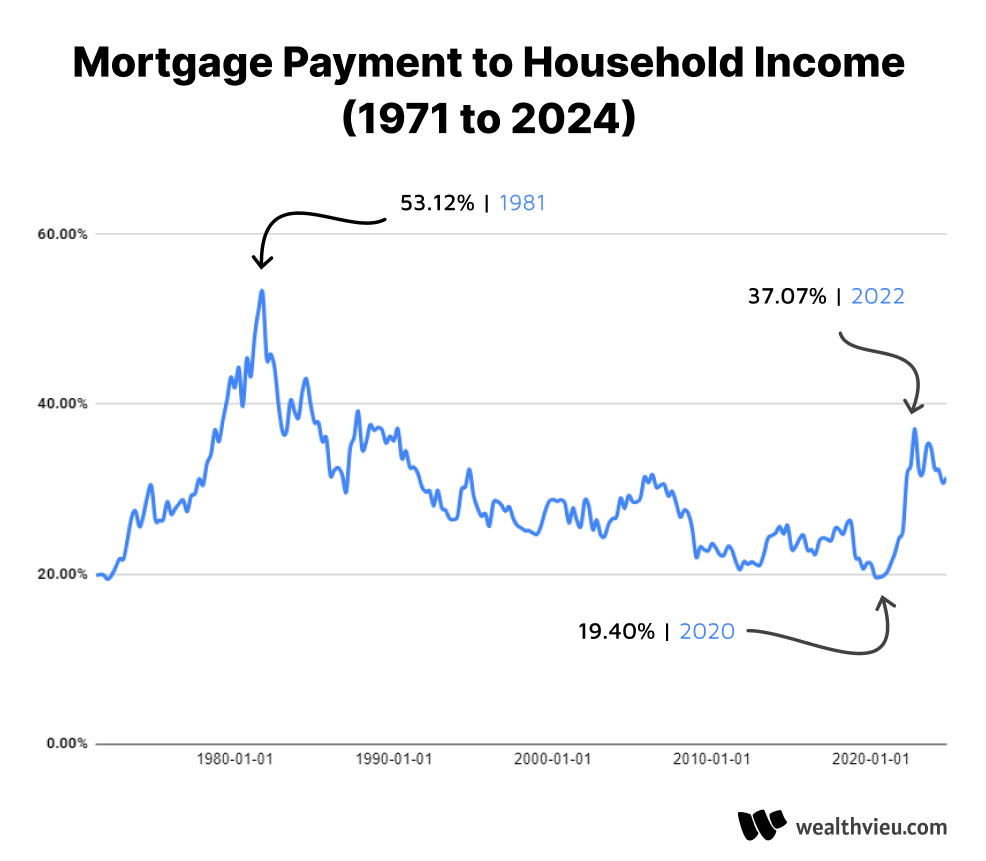
The ratio ignores interest rates, which decide what a buyer actually pays each month. The chart below takes the median new-home price, assumes a 10% down payment and a 30-year fixed loan at that year’s average rate, and shows the monthly principal and interest payment as a share of median household income.
This view tells a different story from the ratio:
- 1981 was the least affordable year. Homes cost only 3.61 times income, but with rates averaging 16.64%, the payment took 54.5% of median household income.
- 2020 was among the most affordable. Rates averaged 3.11%, and the payment took 22.5% of income, close to the 21.2% of 1971 and 1972.
- 2021 to 2023 was a shock. The monthly payment on the median new home rose from $1,447 in 2021 to $2,516 in 2023, a 74% increase in two years. The 2023 share of 37.5% was the highest since 1990.
- 2025 eased to 32.9%, still above every year from 2008 to 2021.
These figures cover principal and interest only. Property taxes, homeowners insurance and mortgage insurance (required with less than 20% down on a conventional loan) add to the real monthly cost.
Where it stands in 2026
Census has not published 2026 household income yet, so the annual series ends in 2025. On the latest figures, the median new home sold for $393,700 in August 2026 (preliminary), and the 30-year rate averaged 7.40% in the week of October 15, 2026. That works out to a payment of about $2,453 a month, or about 33.7% of 2025 median household income. Lower prices have offset most of the recent rise in rates.
On the same basis as the annual figures, the 2026 price-to-income ratio so far is 4.64 and the payment share is 31.6%: the median new-home price averaged about $406,200 from January to August, the 30-year rate averaged 6.48% in the weeks through October 15, and the payment comes to about $2,305 a month. Those are the 2026 points on the two charts above. Both 2026 figures use 2025 income, so they will fall a little once Census publishes 2026 income in September 2027.
How much income it takes to match past affordability
Using 2025’s median new-home price and average rate, the payment is $2,398 a month. Here is the household income it would take for that payment to use the same share of income as in earlier years:
| To match the payment share of | Share of income | Income needed in 2025 |
|---|---|---|
| 1971 | 21.2% | $135,700 |
| 1990 | 39.3% | $73,200 |
| 2000 | 32.1% | $89,600 |
| 2019 | 23.9% | $120,400 |
| 2021 | 24.5% | $117,500 |
The actual 2025 median was $87,460. Getting back to 2019’s payment share with 2025 prices and incomes would take a 30-year rate of about 3.76%.
Full data: home prices, income and payments by year
| Year | Median new-home price | Median household income | Price-to-income | 30-yr rate | Monthly payment (P&I) | Payment share of income |
|---|---|---|---|---|---|---|
| 2025 | $417,400 | $87,460 | 4.77 | 6.60% | $2,398 | 32.9% |
| 2024 | $420,300 | $83,160 | 5.05 | 6.72% | $2,446 | 35.3% |
| 2023 | $428,600 | $80,610 | 5.32 | 6.81% | $2,516 | 37.5% |
| 2022 | $434,500 | $74,580 | 5.83 | 5.34% | $2,182 | 35.1% |
| 2021 | $383,500 | $70,780 | 5.42 | 2.96% | $1,447 | 24.5% |
| 2020 | $330,900 | $68,010 | 4.87 | 3.11% | $1,274 | 22.5% |
| 2019 | $321,500 | $68,700 | 4.68 | 3.94% | $1,371 | 23.9% |
| 2018 | $326,400 | $63,180 | 5.17 | 4.54% | $1,496 | 28.4% |
| 2017 | $323,100 | $61,140 | 5.28 | 3.99% | $1,387 | 27.2% |
| 2016 | $307,800 | $59,040 | 5.21 | 3.65% | $1,268 | 25.8% |
| 2015 | $294,200 | $56,520 | 5.21 | 3.85% | $1,241 | 26.4% |
| 2014 | $288,500 | $53,660 | 5.38 | 4.17% | $1,265 | 28.3% |
| 2013 | $268,900 | $53,590 | 5.02 | 3.98% | $1,152 | 25.8% |
| 2012 | $245,200 | $51,020 | 4.81 | 3.66% | $1,010 | 23.8% |
| 2011 | $227,200 | $50,050 | 4.54 | 4.45% | $1,030 | 24.7% |
| 2010 | $221,800 | $49,280 | 4.50 | 4.69% | $1,034 | 25.2% |
| 2009 | $216,700 | $49,780 | 4.35 | 5.04% | $1,051 | 25.3% |
| 2008 | $232,100 | $50,300 | 4.61 | 6.03% | $1,256 | 30.0% |
| 2007 | $247,900 | $50,230 | 4.94 | 6.34% | $1,386 | 33.1% |
| 2006 | $246,500 | $48,200 | 5.11 | 6.41% | $1,390 | 34.6% |
| 2005 | $240,900 | $46,330 | 5.20 | 5.87% | $1,281 | 33.2% |
| 2004 | $221,000 | $44,330 | 4.99 | 5.84% | $1,172 | 31.7% |
| 2003 | $195,000 | $43,320 | 4.50 | 5.83% | $1,033 | 28.6% |
| 2002 | $187,600 | $42,410 | 4.42 | 6.54% | $1,071 | 30.3% |
| 2001 | $175,200 | $42,230 | 4.15 | 6.97% | $1,046 | 29.7% |
| 2000 | $169,000 | $41,990 | 4.02 | 8.05% | $1,122 | 32.1% |
| 1999 | $161,000 | $40,700 | 3.96 | 7.44% | $1,007 | 29.7% |
| 1998 | $152,500 | $38,890 | 3.92 | 6.94% | $908 | 28.0% |
| 1997 | $146,000 | $37,010 | 3.94 | 7.60% | $928 | 30.1% |
| 1996 | $140,000 | $35,490 | 3.94 | 7.81% | $908 | 30.7% |
| 1995 | $133,900 | $34,080 | 3.93 | 7.93% | $879 | 30.9% |
| 1994 | $130,000 | $32,260 | 4.03 | 8.38% | $890 | 33.1% |
| 1993 | $126,500 | $31,240 | 4.05 | 7.31% | $782 | 30.0% |
| 1992 | $121,500 | $30,640 | 3.97 | 8.39% | $832 | 32.6% |
| 1991 | $120,000 | $30,130 | 3.98 | 9.25% | $888 | 35.4% |
| 1990 | $122,900 | $29,940 | 4.10 | 10.13% | $981 | 39.3% |
| 1989 | $120,000 | $28,910 | 4.15 | 10.32% | $973 | 40.4% |
| 1988 | $112,500 | $27,230 | 4.13 | 10.34% | $914 | 40.3% |
| 1987 | $104,500 | $26,060 | 4.01 | 10.21% | $840 | 38.7% |
| 1986 | $92,000 | $24,900 | 3.69 | 10.19% | $738 | 35.6% |
| 1985 | $84,300 | $23,620 | 3.57 | 12.43% | $806 | 40.9% |
| 1984 | $79,900 | $22,420 | 3.56 | 13.88% | $845 | 45.2% |
| 1983 | $75,300 | $20,890 | 3.60 | 13.24% | $762 | 43.8% |
| 1982 | $69,300 | $20,170 | 3.44 | 16.04% | $841 | 50.0% |
| 1981 | $68,900 | $19,070 | 3.61 | 16.64% | $866 | 54.5% |
| 1980 | $64,600 | $17,710 | 3.65 | 13.74% | $677 | 45.9% |
| 1979 | $62,900 | $16,460 | 3.82 | 11.20% | $548 | 39.9% |
| 1978 | $55,700 | $15,060 | 3.70 | 9.64% | $427 | 34.0% |
| 1977 | $48,800 | $13,570 | 3.60 | 8.85% | $349 | 30.8% |
| 1976 | $44,200 | $12,690 | 3.48 | 8.87% | $316 | 29.9% |
| 1975 | $39,300 | $11,800 | 3.33 | 9.05% | $286 | 29.1% |
| 1974 | $35,900 | $11,200 | 3.21 | 9.19% | $264 | 28.3% |
| 1973 | $32,500 | $10,510 | 3.09 | 8.04% | $216 | 24.6% |
| 1972 | $27,600 | $9,697 | 2.85 | 7.38% | $172 | 21.2% |
| 1971 | $25,200 | $9,028 | 2.79 | 7.54% | $159 | 21.2% |
Sources: Census Bureau and HUD, sales price of new houses sold (annual median); Census Bureau, CPS ASEC Table H-5 (median household income, current dollars; where Census publishes two estimates for 2013 and 2017, the one consistent with later years is used); Freddie Mac PMMS (annual average of weekly 30-year fixed rates). Payments assume 10% down and a 30-year fixed loan, principal and interest only. Ratios and payments are wealthvieu calculations.
Why home prices outgrew incomes
Several forces pushed the ratio up over five decades:
- Falling interest rates from 1981 to 2021. Lower rates let buyers borrow more on the same income, and prices rose to absorb much of that extra borrowing power. This is why the payment share fell for decades even as the price-to-income ratio rose.
- Bigger homes. New homes today are much larger than in the 1970s, so part of the price rise buys more house. (See average home size by state.)
- Land and supply constraints. Zoning, permitting and construction costs have limited how quickly new supply responds to demand in high-cost metros.
- Slow income growth. Median household income grew 9.7-fold in nominal terms from 1971 to 2025, while the median new-home price grew 16.6-fold.
What the ratio doesn’t show
- New vs existing homes. New homes are a minority of sales. In 2026 their median price has been similar to the existing-home median, but the two series have diverged at times.
- Local differences. A single national ratio hides wide differences between metros and states. See the housing affordability gap by state for state-level figures.
- Who is buying. Buyers typically earn more than the median household, so the ratio for actual buyers is lower than the ratio for the median household.
To see what you could afford on your own income, use the mortgage affordability calculator or the income needed to afford a home calculator. For the rate history behind these payments, see mortgage rate history.

The content on Wealthvieu is for informational purposes only and should not be considered financial, tax, or investment advice. Consult a qualified professional before making financial decisions. Full disclaimer · Editorial policy