Understanding how your income compares to other Canadians is one of the most common personal finance questions. Whether you’re negotiating a raise, planning a budget, or deciding where to live, knowing the average and median income benchmarks gives valuable context.
This guide covers the average and median individual income, household income, salary, and income by age group for Canadians using the most recent Statistics Canada data.
Average income in Canada
The average income in Canada is $57,100 and the median income is $43,100. This income includes employment income, investment income, retirement income, and other income sources.
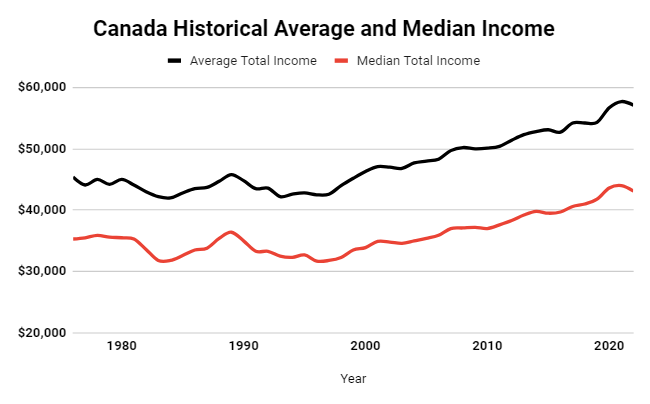
The table below shows the average income in Canada over the past 10 years, inflation-adjusted to the most recent year. The average income has increased from $51,400 in 2012 to a peak of $57,700 in 2021 before settling slightly to $57,100 in 2022.
| Year | Average Income | Median Income |
|---|---|---|
| 2012 | $51,400 | $38,300 |
| 2013 | $52,300 | $39,200 |
| 2014 | $52,800 | $39,800 |
| 2015 | $53,100 | $39,500 |
| 2016 | $52,700 | $39,700 |
| 2017 | $54,200 | $40,600 |
| 2018 | $54,200 | $41,000 |
| 2019 | $54,300 | $41,800 |
| 2020 | $56,700 | $43,600 |
| 2021 | $57,700 | $44,000 |
| 2022 | $57,100 | $43,100 |
The 2020-2021 jump was largely driven by pandemic-era government transfers (CERB, CRB) and a hot labour market. The slight pullback in 2022 reflects the impact of high inflation eroding real income gains.
To see exactly where your income ranks among all Canadians, use the income percentile calculator.
Average historical income in Canada
This graph shows the historical average income in Canada adjusted for inflation.
Average income in Canada by age
Comparing your income by age group provides a more meaningful benchmark than the overall national average. Income in Canada follows the typical career arc — rising sharply through your 30s, peaking in your 40s and 50s, then declining as workers approach retirement.
| Age Group | Average Income | Median Income |
|---|---|---|
| 25 to 34 | $55,000 | $48,100 |
| 35 to 44 | $72,800 | $60,300 |
| 45 to 54 | $77,400 | $60,400 |
| 55 to 64 | $64,300 | $48,900 |
| 65+ | $48,600 | $34,600 |
Peak earning years are 45 to 54, when Canadians average $77,400 per year. This is also the age range where maximizing RRSP contributions and TFSA room becomes most impactful for retirement planning.
The 65+ group still averages $48,600, largely due to CPP, OAS, employer pensions, and investment withdrawal income. See the CPP guide for more information on retirement income sources.
Average household income in Canada
The average household income in Canada is approximately $99,600 before tax. The median household income is $75,400. The significant gap between average and median reflects the impact of high-income households pulling the average upward.
| Metric | Amount |
|---|---|
| Average household income | $99,600 |
| Median household income | $75,400 |
| Average tax paid per household | ~$18,000 |
| Average after-tax household income | ~$81,600 |
Households typically include combined income from two or more earners, which is why the household figure is substantially higher than the individual average. According to Statistics Canada, the majority of Canadian households have two or more income earners.
For budgeting purposes, the after-tax household income is most relevant. Use the salary after tax calculator to estimate your household’s take-home pay.
Average salary in Canada
You may be wondering how your salary specifically compares. The average salary in Canada is $55,300 and the median salary is $42,400. This is slightly lower than the average income of $57,100 because income includes non-employment sources like investments, rental income, and government transfers.
| Year | Average Salary | Median Salary |
|---|---|---|
| 2012 | $51,100 | $38,600 |
| 2013 | $52,200 | $39,200 |
| 2014 | $52,500 | $39,700 |
| 2015 | $52,800 | $39,700 |
| 2016 | $52,300 | $39,300 |
| 2017 | $52,900 | $39,600 |
| 2018 | $53,200 | $40,300 |
| 2019 | $52,500 | $41,000 |
| 2020 | $52,400 | $39,800 |
| 2021 | $55,100 | $42,200 |
| 2022 | $55,300 | $42,400 |
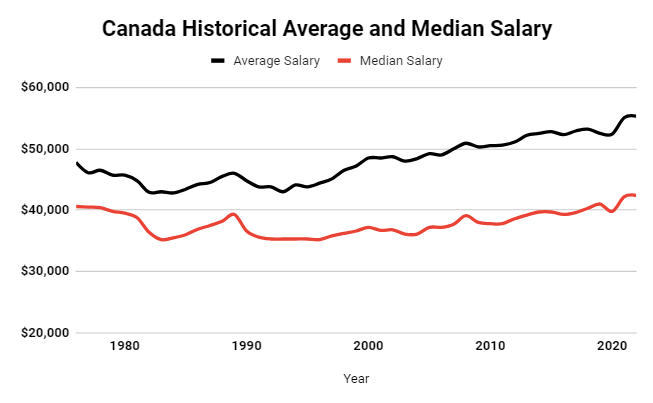
The 2020 dip in median salary reflects pandemic-era job losses concentrated among lower-wage workers. The recovery in 2021-2022 was driven by a tight labour market and minimum wage increases across provinces.
Average historical salary in Canada
This graph shows the historical average salary in Canada adjusted for inflation.
Average vs. median: which number should you use?
The median is generally the better benchmark for comparing your income to “typical” Canadians. High-income earners skew the average upward, making it appear higher than what most Canadians actually earn.
For example, the average income is $57,100 but the median is only $43,100 — meaning half of Canadians earn less than $43,100. If you earn $50,000, you might feel behind the “average” but you are actually above the median.
Average income by province
Income varies significantly across provinces, largely driven by industry mix and cost of living:
| Province | Average Individual Income |
|---|---|
| Alberta | $62,400 |
| Ontario | $58,900 |
| British Columbia | $54,500 |
| Saskatchewan | $52,100 |
| Manitoba | $48,600 |
| Quebec | $48,200 |
| Newfoundland | $44,600 |
| New Brunswick | $44,300 |
| Nova Scotia | $44,200 |
| PEI | $41,600 |
Alberta leads due to the resource/energy sector, while Atlantic provinces have lower averages but also significantly lower living costs. See the cost of living by province guide for a complete comparison.
For detailed breakdowns by province, explore:
- Average income in Ontario
- Average income in Alberta
- Average income in British Columbia
- Average income in PEI
- Average income in Nova Scotia
- Average income in New Brunswick
What is considered a good salary in Canada?
Whether a salary is “good” depends on your location and lifestyle. As general benchmarks:
- $50,000-$60,000 — around the national average, comfortable in most cities outside Toronto and Vancouver
- $75,000-$100,000 — above average, allows for savings and homeownership in most markets
- $100,000+ — places you well above the national average and in approximately the top 15-20% of earners
See the guides for whether $50,000, $60,000, $75,000, or $100,000 is a good salary for more detailed analysis.
Data sources
The incomes listed in this article are based on data released by Statistics Canada in the most recent Canadian Income Survey (CIS) completed for the 2022 year and released on 2024-04-26. Salary data comes from the same survey. Historical figures are inflation-adjusted to the most recent survey year.
Frequently asked questions
What is the average household income in Canada?
The average household income in Canada is approximately $99,600 before tax. The median household income is $75,400.
What is the average individual income in Canada?
The average individual income in Canada is $57,100 before tax and $48,100 after tax.
What is the difference between average income and average salary?
The average income ($57,100) includes all income sources — employment, investments, government transfers, and retirement income. The average salary ($55,300) includes only employment income.
How does the average salary compare to the median salary?
The average salary is $55,300 while the median is $42,400. The median is lower because high earners pull the average up. Half of Canadians earn less than the median.